
Alternative Dispute Resolution in Law in the UAE
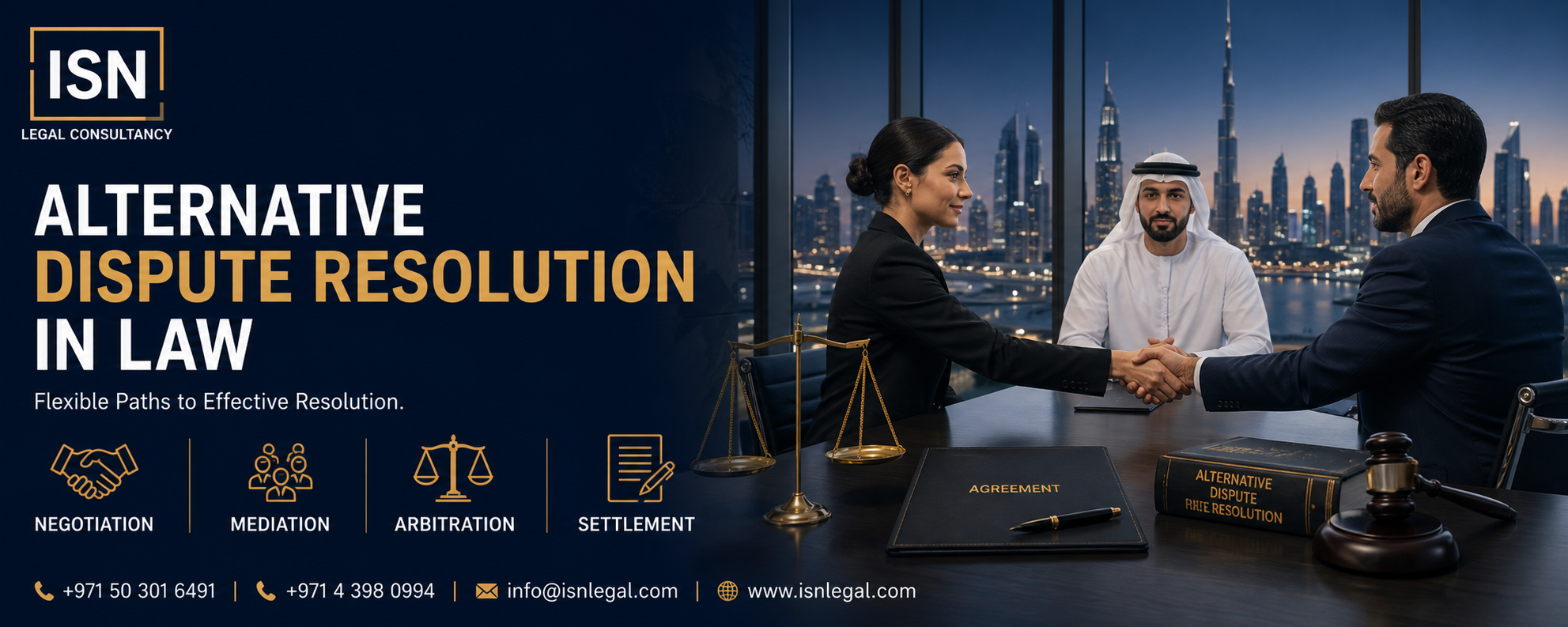
Alternative Dispute Resolution in Law refers to legal methods used to resolve disagreements without relying exclusively on conventional contested court litigation. Depending on the nature of the dispute and the parties’ agreement, these methods can include negotiation, mediation, conciliation, and arbitration.
For individuals and businesses in the UAE, alternative dispute resolution can provide practical options for addressing commercial, contractual, property, construction, and other civil disputes. However, the appropriate method depends on the nature of the legal relationship, whether the dispute is capable of settlement or arbitration, and whether the parties have previously agreed to a particular dispute-resolution mechanism.
At ISN Legal Consultancy, we advise individuals, companies, investors, and businesses on Alternative Dispute Resolution in Law, helping clients assess their disputes, understand available resolution mechanisms, negotiate settlements, evaluate mediation or arbitration provisions, and determine whether an alternative process or formal litigation is more appropriate.
What Is Alternative Dispute Resolution in Law?
Alternative Dispute Resolution, commonly referred to as ADR, covers mechanisms through which parties seek to resolve legal disagreements outside traditional contested litigation.
Depending on the dispute, ADR may include:
- Direct negotiation.
- Mediation.
- Conciliation.
- Arbitration.
- Contractually agreed dispute-resolution procedures.
- Structured settlement discussions.
These mechanisms are not interchangeable.
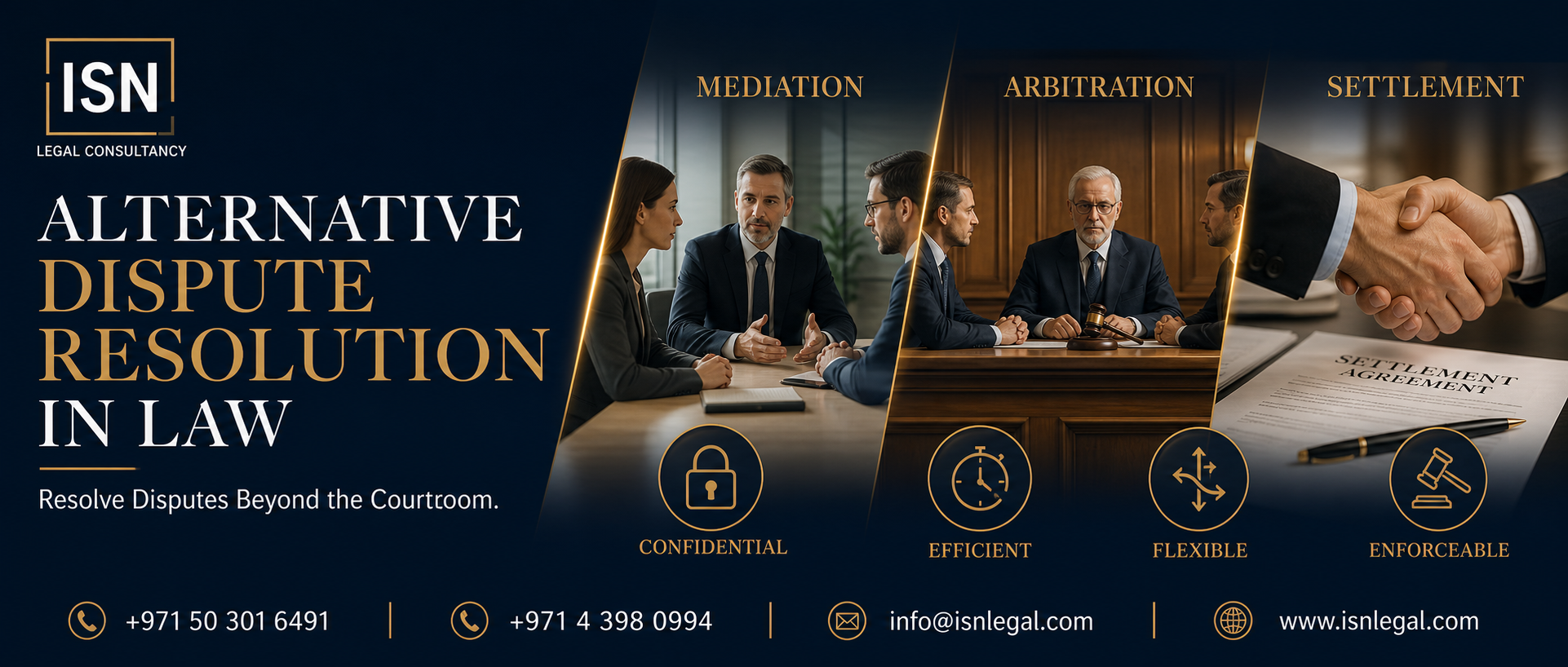
Mediation, for example, is designed to facilitate an amicable agreement between the parties, while arbitration generally involves submitting a dispute to an arbitral tribunal for determination.
For a broader overview of legal disagreements and available methods of resolving them, see our Legal Dispute pillar page.
Alternative Dispute Resolution Framework in the UAE
The UAE has developed specific legislative frameworks for different forms of alternative dispute resolution.
Mediation and conciliation in civil and commercial disputes are governed by the applicable federal mediation and conciliation legislation, while arbitration is principally governed by Federal Law No. (6) of 2018 Concerning the Arbitration, as amended.
These frameworks recognise different methods through which parties may address disputes without proceeding entirely through conventional court litigation.
The correct framework depends on the dispute and the method selected.
Parties should therefore determine whether they are pursuing negotiation, mediation, conciliation, arbitration, or another agreed procedure before deciding how to proceed.
Negotiation as a Dispute Resolution Method
Negotiation is often the first attempt to resolve a disagreement.
The parties communicate directly, or through their legal advisers, with the aim of reaching terms acceptable to both sides.
Negotiations may address:
- Outstanding payments.
- Contractual performance.
- Termination.
- Compensation.
- Property-related obligations.
- Delivery or completion obligations.
- Future commercial arrangements.
Negotiation can be particularly valuable where the parties want to preserve an existing commercial relationship.
However, negotiations should be approached strategically. A party should understand its legal position and available evidence before agreeing to concessions or settlement terms.
Mediation in Legal Disputes
Mediation involves a neutral mediator assisting parties in attempting to resolve their dispute amicably.
Unlike a judge deciding a contested court case, a mediator’s role is focused on facilitating communication and helping the parties explore settlement.
Mediation can be relevant to civil and commercial disagreements where the subject matter is legally capable of settlement.
Potential advantages may include:
- Greater involvement of the parties in determining the outcome.
- Opportunity to preserve commercial relationships.
- Flexibility in exploring settlement terms.
- Reduced adversarial conflict.
- Potential avoidance of prolonged litigation.
Whether mediation is appropriate depends on the circumstances and the willingness of the parties to participate constructively.
Conciliation in the UAE
Conciliation is another mechanism intended to facilitate amicable settlement.
The UAE legal framework provides for conciliation in qualifying civil and commercial disputes through the mechanisms established by applicable legislation.
Conciliation may be useful where the parties need a structured process for discussing possible settlement before or instead of pursuing contested proceedings.
The legal effect of any settlement should be understood before it is concluded, particularly where the agreement is intended to bring an existing dispute or proceeding to an end.
Arbitration as Alternative Dispute Resolution
Arbitration differs significantly from negotiation and mediation.
Rather than assisting the parties to negotiate their own settlement, an arbitral tribunal considers the dispute and issues an arbitral award.
Arbitration generally depends on the existence of a valid arbitration agreement.
The UAE Arbitration Law regulates important matters including:
- Arbitration agreements.
- Appointment of arbitrators.
- Tribunal jurisdiction.
- Arbitration procedures.
- Interim and precautionary measures.
- Arbitral awards.
- Challenges to awards.
- Recognition and enforcement.
Businesses should review their contracts carefully before commencing court litigation because an applicable arbitration agreement may affect the forum in which the dispute should be resolved.
ADR vs Dispute Litigation
Choosing between ADR and Dispute Litigation requires consideration of the particular dispute rather than assuming that one approach is always preferable.
Litigation provides a formal judicial process through which the competent court determines the dispute.
ADR may offer greater flexibility in suitable cases, particularly where the parties remain capable of negotiation or have agreed to arbitration.
Factors to consider include:
- Nature of the dispute.
- Relationship between the parties.
- Contractual dispute-resolution provisions.
- Need for urgent relief.
- Complexity of the evidence.
- Confidentiality considerations.
- Location of the parties or assets.
- Whether a binding determination is required.
- Possibility of settlement.
- Enforcement considerations.
Legal advice can help determine which mechanism is most appropriate.
Alternative Dispute Resolution in Commercial Disputes
Our International Commercial Dispute Resolution guide explains the wider choices for cross-border businesses.
Commercial relationships frequently benefit from carefully structured dispute-resolution procedures.
Disputes may arise between:
- Suppliers and purchasers.
- Companies and service providers.
- Business partners.
- Contractors and employers.
- Shareholders.
- Distributors.
- Investors.
- Other commercial parties.
A commercial contract may establish a staged procedure requiring negotiation or another preliminary process before arbitration or litigation.
Businesses should review these provisions before commencing proceedings to ensure that any agreed procedural requirements are properly considered.
ADR in Contractual Disputes
Our Contract Dispute Law page explains the breach and performance issues behind many settlement talks.
Contractual disputes are particularly suitable for early assessment of alternative resolution options.
A dispute may concern:
- Non-payment.
- Failure to perform.
- Delays.
- Defective performance.
- Termination.
- Interpretation of contractual provisions.
- Damages.
- Outstanding obligations.
Negotiated settlement may allow the parties to restructure obligations rather than simply ending their relationship.
For example, parties may agree on revised payment arrangements, additional performance periods, modified obligations, or an agreed termination.
Any settlement should be clearly documented to reduce the risk of further disagreement.
Alternative Dispute Resolution in International Trade
See Dispute Resolution in International Trade for supply, payment, and delivery disputes across borders.
Cross-border transactions can create additional complexity because parties may operate in different jurisdictions.
International disputes may raise questions concerning:
- Applicable law.
- Jurisdiction.
- Arbitration clauses.
- Location of proceedings.
- Language.
- Cross-border enforcement.
- Foreign assets.
- International commercial relationships.
Where international trade relationships are involved, dispute-resolution clauses can be particularly important.
Our Dispute Resolution in International Trade page provides more focused guidance on resolving cross-border commercial and trade disputes.
ADR in Property Disputes
Legal Advice on Property Dispute covers ownership and transaction claims, while Tenant Landlord Disputes focuses on leases.
Property disputes may sometimes be suitable for negotiated or mediated resolution depending on the nature of the rights involved and whether the subject matter is legally capable of settlement.
Potential disputes may concern:
- Contractual property obligations.
- Payment.
- Boundaries or use.
- Development arrangements.
- Shared property issues.
- Neighbour-related disagreements.
- Other property-related contractual matters.
Where mediation is appropriate, the parties may have greater flexibility to explore practical solutions that address their continuing relationship or use of the property.
Our Legal Advice on Property Dispute page addresses broader property dispute considerations.
ADR in Contractor Disputes
Contractor disputes may involve payment, delays, variations, performance, defects, additional works, or termination.
Before commencing litigation, parties should examine the contract to determine whether it establishes:
- Negotiation requirements.
- Notice procedures.
- Mediation or conciliation.
- Arbitration.
- Other dispute-resolution steps.
Some contractor disputes also involve substantial technical evidence, making early identification of the disputed issues particularly important.
Family Disputes and Alternative Resolution
Family Law Disputes explains family-specific concerns that may affect settlement.
Certain Family Law Disputes may involve opportunities for reconciliation or amicable resolution under the applicable personal status framework.
However, family disputes require particular care because not every issue can simply be resolved through ordinary commercial ADR principles.
Matters involving children, personal status rights, maintenance, or other family obligations may be subject to specific statutory requirements.
Any proposed settlement should therefore be assessed under the family-law framework applicable to the parties.
Benefits of Resolving Disputes Amicably
Where appropriate, an amicable resolution can offer practical advantages.
Parties may be able to:
- Avoid prolonged contested proceedings.
- Preserve business relationships.
- Reduce uncertainty.
- Develop commercially practical solutions.
- Resolve several connected issues together.
- Agree payment arrangements.
- Establish future contractual obligations.
- Control aspects of the settlement outcome.
These benefits depend on genuine willingness to negotiate and the nature of the dispute.
ADR should not be used merely to delay legitimate claims or prevent a party from protecting its rights.
When ADR May Not Resolve the Dispute
See Dispute Litigation for what happens if a claim proceeds to court.
Alternative dispute resolution does not guarantee settlement.
Formal proceedings may become necessary where:
- One party refuses meaningful participation.
- Liability is fundamentally disputed.
- Urgent judicial protection is required.
- Negotiations repeatedly fail.
- The parties require a binding judicial determination.
- The dispute concerns matters that cannot legally be resolved through the proposed ADR mechanism.
Where settlement cannot be achieved, Dispute Litigation may provide the appropriate route for obtaining a judicial determination.
Where a valid arbitration agreement applies, arbitration may instead be the required dispute-resolution forum.
Preparing for Alternative Dispute Resolution
Effective ADR requires preparation.
Before entering negotiations or mediation, a party should understand:
- The underlying legal relationship.
- The disputed obligations.
- The relevant contractual provisions.
- Available evidence.
- Potential financial exposure.
- Desired outcome.
- Acceptable settlement parameters.
- Alternatives if settlement fails.
Relevant evidence may include contracts, invoices, payment records, correspondence, notices, expert reports, property documents, and other materials connected with the dispute.
Understanding the strength and weaknesses of the legal position can help parties negotiate more effectively.
Settlement Agreements
Where the parties successfully resolve a dispute, the terms should be recorded clearly.
A settlement agreement may address:
- Payment obligations.
- Deadlines.
- Performance requirements.
- Release or resolution of claims.
- Termination of contractual relationships.
- Confidentiality where appropriate.
- Consequences of non-performance.
- Other agreed obligations.
The settlement should accurately reflect the parties’ agreement and be structured according to the applicable legal framework.
Where a settlement occurs within a statutory mediation, conciliation, or judicial procedure, additional rules may govern its approval or enforceability.
Choosing the Appropriate Dispute Resolution Method
There is no single dispute-resolution mechanism suitable for every legal disagreement.
The appropriate choice depends on factors such as:
- Whether the parties have an existing contract.
- Whether that contract contains an arbitration clause.
- Whether continued cooperation is desirable.
- Whether the dispute is capable of amicable settlement.
- Whether urgent action is required.
- Whether the parties need a binding determination.
- Whether the dispute has an international element.
- Where assets are located.
- The complexity and value of the claim.
Reviewing these issues early can prevent parties from pursuing an unsuitable procedure.
Our Alternative Dispute Resolution Services
ISN Legal Consultancy advises individuals and businesses on different methods of resolving legal disputes.
Our services include:
- Assessing legal disputes.
- Reviewing dispute-resolution clauses.
- Advising on negotiation strategy.
- Reviewing mediation options.
- Advising on conciliation.
- Reviewing arbitration agreements.
- Assessing settlement proposals.
- Drafting and reviewing settlement terms.
- Organising supporting evidence.
- Advising on commercial disputes.
- Advising on property disputes.
- Advising on contractor disputes.
- Assessing international dispute-resolution options.
- Advising on litigation where ADR is unsuccessful.
Why Choose ISN Legal Consultancy?
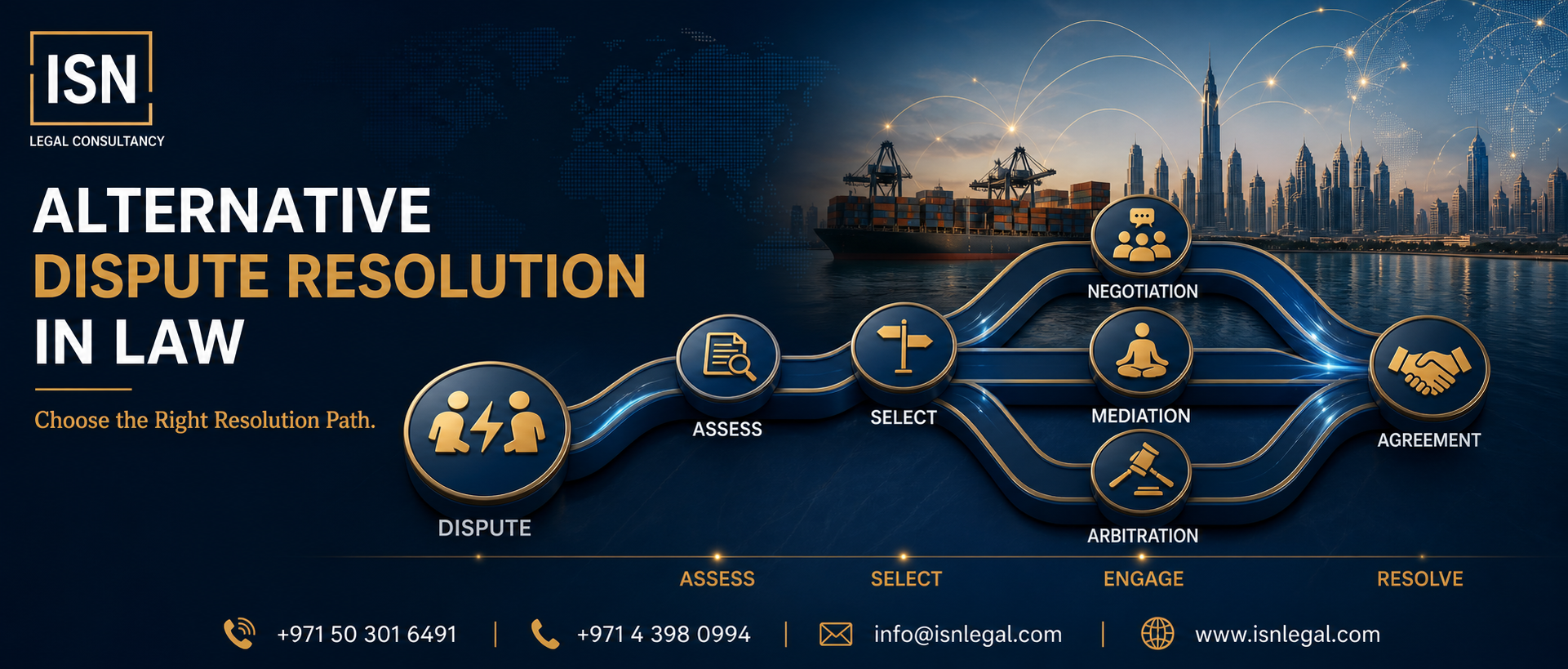
Effective dispute resolution begins with understanding the legal position before choosing the procedure.
ISN Legal Consultancy helps clients evaluate the nature of the dispute, contractual provisions, applicable legal framework, evidence, commercial objectives, and available resolution mechanisms.
Where negotiation or mediation offers a realistic opportunity for settlement, we help clients assess that option. Where litigation or arbitration is necessary, we help identify the appropriate next steps and legal strategy.
Related Legal Services
- Legal Dispute – Our main pillar covering legal disputes and resolution options in the UAE.
- Dispute Litigation – Guidance on disputes requiring formal court proceedings.
- Dispute Resolution in International Trade – Guidance on resolving cross-border commercial and trade disputes.
- Legal Advice on Property Dispute – Advice on property-related legal disagreements.
- Family Law Disputes – Guidance on family and personal status disagreements where specialised legal rules apply.
- Contract Dispute Law – Breach, payment, interpretation, and termination of agreements.
- Civil Law Disputes – Private claims involving rights, debts, property, or compensation.
- Real Estate Dispute Law Firm – Property sale, ownership, developer, and lease disputes.
- International Commercial Dispute Resolution – Cross-border business claims and choices of forum.
- Tenant Landlord Disputes – Rent, eviction, repairs, deposits, and lease issues.
- Disputed Wills – Challenges involving wills, estates, and beneficiaries.
Frequently Asked Questions
Can I settle a legal dispute without going to court in the UAE?
Yes. Depending on the nature of the dispute, you may be able to resolve it through negotiation, mediation, conciliation, or arbitration instead of proceeding through conventional court litigation. The appropriate option depends on the dispute, the contract between the parties, and whether the matter is legally capable of settlement.
My business partner owes me money. Can I settle the dispute without filing a court case?
Potentially, yes. A commercial payment dispute can sometimes be resolved through direct negotiation, mediation, or another agreed dispute-resolution process. Before accepting any settlement, it is important to review the underlying agreement, payment records, correspondence, and your legal position so that you do not give up rights unnecessarily.
I sent a legal notice but the other party is not responding. What can I do?
If the other party does not respond to a legal notice, you may still have options. Depending on the dispute, you may consider negotiation, mediation, conciliation, arbitration, or court proceedings. The next step should be determined by the contract, the nature of the claim, any applicable deadlines, and whether urgent legal action is required.
Can I negotiate with the other party after a legal dispute has started?
Yes. The fact that a dispute has already developed does not necessarily prevent the parties from negotiating a settlement. In many cases, the parties can continue settlement discussions while preparing for or even during formal proceedings.
What is the difference between mediation and arbitration in the UAE?
Mediation is a process in which a neutral mediator helps the parties try to reach their own agreement. Arbitration is different because an arbitral tribunal considers the dispute and issues an arbitral award. Arbitration generally depends on a valid arbitration agreement between the parties.
My contract has an arbitration clause. Do I have to go to arbitration?
If the contract contains a valid arbitration agreement that covers the dispute, it may affect whether the dispute should be brought before the courts or referred to arbitration. The exact wording of the arbitration clause should be reviewed before starting proceedings because its scope and validity can be important.
Can I go to court if my contract says disputes must be resolved through arbitration?
It depends on the arbitration agreement and the circumstances of the dispute. A valid arbitration clause may mean that arbitration is the appropriate forum for disputes falling within its scope. The contract should be reviewed before filing a court case.
How long does mediation take in the UAE?
The time required depends on the complexity of the dispute, the number of issues involved, the parties’ willingness to negotiate, and the applicable mediation process. Some disputes may be resolved relatively quickly, while more complex commercial disputes may require more time.
Is a settlement agreement legally binding in the UAE?
A properly prepared settlement can create binding obligations between the parties. However, its legal effect and enforceability can depend on how and where the settlement is concluded and the applicable legal framework. Settlement terms should therefore be reviewed carefully before signing.
What happens if the other party refuses to participate in mediation?
Mediation generally depends on the parties’ participation and willingness to seek a settlement, subject to the particular legal framework or agreement governing the process. If mediation does not resolve the dispute, the parties may need to consider arbitration or litigation, depending on their contractual and legal rights.
Can I use mediation for a property dispute in Dubai?
Potentially, yes. Some property-related disputes may be suitable for negotiation or mediation, particularly where the parties are trying to resolve contractual, payment, development, or other issues that are legally capable of settlement. The nature of the property rights involved should be reviewed before choosing mediation.
Can I settle a dispute with my contractor without going to court?
Yes. Contractor disputes involving payment, delays, defective work, variations, additional works, or termination may sometimes be resolved through negotiation, mediation, or another dispute-resolution mechanism. The construction contract should first be checked for any required notice, negotiation, mediation, or arbitration procedure.
What should I do before agreeing to a settlement?
Before accepting a settlement, you should understand your legal position, the amount or rights you may be giving up, the obligations of the other party, payment deadlines, and what happens if the settlement is breached. The settlement should clearly state what each party must do and how the existing dispute will be resolved.
Can a lawyer negotiate a settlement for me in the UAE?
Yes. A legal consultant or lawyer can assist in assessing your legal position, communicating with the other party, negotiating settlement terms, reviewing proposals, and helping structure an agreement. Professional advice can be particularly useful where the dispute involves substantial financial or contractual rights.
What if the other party refuses to settle my legal dispute?
If negotiation or mediation fails, the available next step depends on the dispute and the agreement between the parties. You may need to consider formal litigation or arbitration if the dispute cannot be resolved amicably. The contract should be reviewed first to determine whether a specific dispute-resolution procedure applies.
Is mediation better than going to court in the UAE?
Not necessarily. Mediation can be useful when both parties are genuinely willing to negotiate and want to avoid prolonged contested proceedings. However, some disputes require a binding determination, urgent protection, or formal enforcement, making arbitration or litigation more appropriate.
How much does it cost to settle a legal dispute without going to court?
The cost depends on the nature and value of the dispute, the complexity of the issues, the documents involved, and the dispute-resolution method used. Negotiation may involve fewer procedural costs than formal litigation, while mediation or arbitration can involve professional and procedural fees. The likely costs should be assessed based on the specific dispute.
Can I settle a debt dispute through mediation in Dubai?
A debt or payment dispute may be suitable for negotiation, mediation, or another settlement process where the matter is legally capable of settlement. The parties may, for example, negotiate a payment plan, partial settlement, or agreed repayment schedule instead of continuing with contested proceedings.
What happens if I settle a dispute and the other party does not pay?
The consequences depend on the terms and legal form of the settlement. A properly structured settlement should address payment deadlines and the consequences of non-compliance. Depending on how the settlement was concluded, further legal or enforcement steps may be available if the other party fails to perform.
Should I try mediation before filing a court case in the UAE?
It may be appropriate in some disputes, but it is not automatically the right step in every case. Before delaying proceedings, you should check whether there are limitation or procedural issues, whether urgent action is required, and whether the contract requires negotiation, mediation, or arbitration before litigation.
Conclusion
Alternative Dispute Resolution in Law provides individuals and businesses with different mechanisms for addressing legal disagreements without relying exclusively on contested court litigation.
Negotiation, mediation, conciliation, and arbitration serve different purposes, and the appropriate method depends on the dispute, contractual arrangements, legal framework, evidence, and objectives of the parties.
At ISN Legal Consultancy, we advise clients on Alternative Dispute Resolution in Law, helping them assess disputes, review contractual dispute-resolution provisions, explore settlement opportunities, and determine whether negotiation, mediation, arbitration, or litigation provides the appropriate route forward.
Contact ISN Legal Consultancy
If you require legal advice regarding Alternative Dispute Resolution in Law in the UAE, contact ISN Legal Consultancy. Our legal consultants can review your dispute, contractual arrangements, evidence, and objectives and advise you on suitable options for negotiation, settlement, mediation, arbitration, or formal proceedings.
