
Institutional Arbitration in the UAE
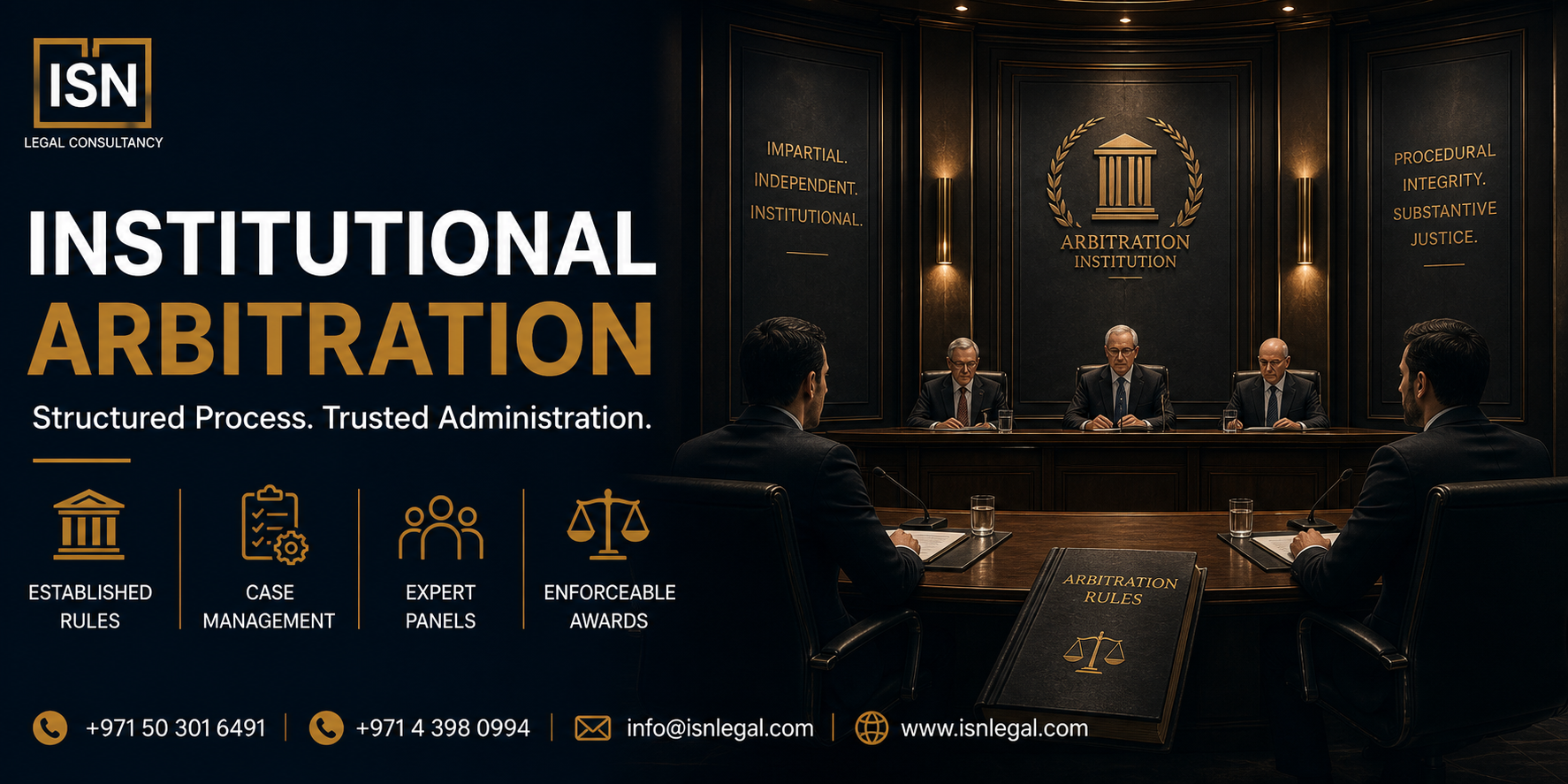
Institutional Arbitration is a form of arbitration administered by a specialised arbitral institution under established procedural rules. Rather than requiring the parties and arbitral tribunal to organise every procedural aspect independently, institutional arbitration provides an established framework for administering the proceedings, appointing arbitrators where required, dealing with certain procedural applications, and managing the arbitration from commencement through the issuance of an award.
In the UAE, institutional arbitration plays an important role in resolving commercial, corporate, construction, investment, international trade, and other arbitrable disputes. Parties may agree in their contracts to refer disputes to an established arbitration institution such as the Dubai International Arbitration Centre (DIAC).
Institutional arbitration conducted within the scope of the UAE federal arbitration framework is principally governed by Federal Law No. (6) of 2018 Concerning Arbitration, as amended, together with the applicable institutional rules selected by the parties.
At ISN Legal Consultancy, we advise companies, investors, contractors, shareholders, suppliers, and other commercial parties on Institutional Arbitration, helping clients review arbitration clauses, identify the applicable institutional framework, assess claims and defences, organise evidence, and understand the procedures relevant to their dispute.
What Is Institutional Arbitration?
Institutional Arbitration occurs when parties agree that their arbitration will be administered according to the rules and procedures of a particular arbitration institution.
The institution does not ordinarily decide the merits of the dispute itself. The dispute is determined by the arbitral tribunal, while the institution performs administrative and procedural functions according to its rules.
Institutional arbitration may provide procedures concerning:
- Commencement of arbitration.
- Submission of requests and responses.
- Appointment of arbitrators.
- Challenges to arbitrators.
- Administrative fees.
- Emergency arbitrators.
- Consolidation.
- Multiple contracts and parties.
- Conduct of proceedings.
- Issuance of awards.
The precise procedures depend on the institution and rules selected by the parties.
For a broader explanation of arbitration agreements, tribunals, proceedings, awards, and enforcement, see our Arbitration pillar page.
UAE Legal Framework for Institutional Arbitration
The principal federal framework is Federal Law No. (6) of 2018 Concerning Arbitration, as amended by Federal Decree-Law No. (15) of 2023.
The Arbitration Law addresses matters including:
- Arbitration agreements.
- Arbitrability.
- Appointment and requirements of arbitrators.
- Tribunal jurisdiction.
- Arbitration proceedings.
- Interim and precautionary measures.
- Evidence.
- Arbitral awards.
- Annulment.
- Recognition and enforcement.
Where the parties choose institutional arbitration, the applicable institutional rules operate alongside the relevant arbitration law.
It is therefore important to distinguish between the governing arbitration legislation and the procedural rules of the institution administering the particular case.
Choosing an Arbitration Institution
Our Tahkeem Arbitration page explains another UAE administering centre alongside DIAC Arbitration.
Parties may select an arbitration institution when drafting their commercial agreement.
The appropriate choice can depend on factors such as:
- Nature of the transaction.
- Location of the parties.
- Seat of arbitration.
- Value of potential disputes.
- Complexity of the transaction.
- Institutional rules.
- Administrative procedures.
- Available emergency mechanisms.
- Arbitrator appointment procedures.
- International aspects of the transaction.
The choice should ideally be made when the underlying contract is negotiated rather than after a dispute has already developed.
A clear institutional arbitration clause can reduce uncertainty regarding how future proceedings should be administered.
Dubai International Arbitration Centre
The Dubai International Arbitration Centre (DIAC) is an important arbitral institution based in Dubai.
DIAC’s current arbitration framework is governed institutionally by Decree No. (34) of 2021 Concerning the Dubai International Arbitration Centre and the DIAC Arbitration Rules 2022.
The 2021 Decree reorganised Dubai’s arbitration institutional framework and established DIAC as the relevant institution under that framework.
The DIAC Arbitration Rules 2022 regulate important procedural matters including:
- Commencement of arbitration.
- Responses and counterclaims.
- Appointment of tribunals.
- Multiple contracts.
- Consolidation.
- Joinder.
- Emergency arbitrators.
- Expedited proceedings.
- Interim measures.
- Conduct of proceedings.
- Awards.
- Costs.
Parties contemplating DIAC arbitration should review both their arbitration agreement and the applicable DIAC Rules.
Institutional Arbitration Agreements
An Arbitration Lawyer can help ensure the clause identifies the institution, rules, and seat clearly.
Institutional arbitration depends on a valid arbitration agreement.
A commercial contract may specify that disputes will be referred to a particular institution and administered under that institution’s arbitration rules.
The arbitration clause should clearly address the intended mechanism.
Important matters may include:
- Selected arbitration institution.
- Applicable arbitration rules.
- Seat of arbitration.
- Number of arbitrators.
- Language.
- Governing law where appropriate.
- Scope of disputes covered by arbitration.
Unclear references to institutions or conflicting procedural provisions can create unnecessary jurisdictional or administrative disagreements.
The arbitration clause should therefore be drafted carefully and consistently.
Commencing Institutional Arbitration
Institutional arbitration generally begins by submitting the required request or notice to the chosen arbitration institution in accordance with its rules.
For example, proceedings under the DIAC Arbitration Rules involve procedural requirements concerning the commencement of arbitration and the information that must accompany a request.
Depending on the institutional framework, the initiating documents may address matters such as:
- Parties to the arbitration.
- Arbitration agreement.
- Contractual relationship.
- Nature of the dispute.
- Claims.
- Relief requested.
- Proposed arbitrator arrangements.
- Supporting documentation.
The respondent is then provided with an opportunity to respond according to the applicable rules.
Appointment of Arbitrators
One important function of arbitral institutions is supporting the process for constituting the arbitral tribunal.
The parties may have agreed on:
- A sole arbitrator.
- A three-member tribunal.
- A specific appointment procedure.
Where the agreed process cannot be completed, the applicable arbitration legislation and institutional rules can provide mechanisms for completing the tribunal’s constitution.
The UAE Arbitration Law establishes statutory requirements concerning arbitrators, including independence and impartiality.
Institutional rules can supplement these requirements through procedures governing appointments, disclosures, and challenges.
Challenges to Arbitrators
Parties must be able to raise legitimate concerns regarding the independence, impartiality, or eligibility of an arbitrator.
Institutional rules generally provide procedures and timeframes for challenging an arbitrator.
A challenge is not simply a mechanism for removing an arbitrator because a party disagrees with a procedural decision.
The challenge must be based on grounds recognised by the applicable legal and institutional framework.
Parties should therefore assess any potential challenge carefully and act within the relevant procedural requirements.
Tribunal Jurisdiction in Institutional Arbitration
The arbitral tribunal must have jurisdiction over the dispute.
Questions may arise concerning:
- Existence of the arbitration agreement.
- Validity of the agreement.
- Scope of the arbitration clause.
- Whether the particular dispute falls within the agreement.
- Whether the subject matter is capable of arbitration.
The UAE Arbitration Law recognises the principle that an arbitral tribunal may rule on its own jurisdiction, including objections concerning the existence or validity of the arbitration agreement.
Jurisdictional objections should be raised according to the applicable procedural requirements.
Institutional Commercial Arbitration
Institutional arbitration is frequently used for commercial disputes.
These disputes may arise from:
- Supply agreements.
- Service contracts.
- Distribution arrangements.
- Joint ventures.
- Shareholder agreements.
- Construction contracts.
- Corporate transactions.
- International sales.
- Other commercial relationships.
Institutional procedures can be particularly useful where the dispute involves multiple claims, substantial documentation, complex contractual arrangements, or international parties.
Our Commercial Arbitration page provides more focused guidance on arbitration involving business and contractual disputes.
International Commercial Arbitration
For a DIFC seat, see DIFC Arbitration Law for the applicable framework.

Institutional arbitration is also widely used in international commercial relationships.
Parties from different jurisdictions may prefer to agree in advance on an established arbitral institution rather than leaving disputes to the national courts of either party.
International institutional arbitration may involve:
- Foreign parties.
- Cross-border contracts.
- Different governing laws.
- Overseas evidence.
- International witnesses.
- Foreign assets.
- Cross-border enforcement.
For disputes involving international commercial relationships, see our International Commercial Arbitration page.
Institutional Arbitration in International Trade
International trade contracts often contain institutional arbitration clauses.
Disputes may concern:
- International sales.
- Supply agreements.
- Distribution.
- Delivery.
- Payment.
- Product specifications.
- Import and export relationships.
- Termination.
Selecting an institution in advance can provide the parties with a defined procedural framework if a dispute later arises.
Our Arbitration in International Trade page provides more detailed guidance on arbitration involving international trade transactions.
Institutional Arbitration in Construction Contracts
Construction contracts frequently contain arbitration provisions.
Institutional arbitration may be used for disputes involving:
- Payment.
- Delays.
- Variations.
- Extensions of time.
- Defects.
- Additional costs.
- Termination.
- Technical performance.
Construction disputes can involve significant documentation and specialist expert evidence, making procedural organisation particularly important.
Our Arbitration in Construction Contracts page provides focused guidance on construction arbitration.
Institutional Corporate Arbitration
Investment Arbitration explains why treaty-based investor-State disputes differ from corporate contract claims.
Corporate and shareholder agreements may also provide for institutional arbitration.
Disputes may involve:
- Shareholder agreements.
- Joint ventures.
- Corporate contracts.
- Investment relationships.
- Commercial obligations between stakeholders.
Whether a particular corporate dispute can be arbitrated depends on the arbitration agreement and the nature of the rights involved.
Our Corporate Arbitration page provides further guidance on arbitration involving corporate relationships.
Emergency Arbitration
Some institutional rules provide mechanisms for obtaining urgent relief before the ordinary arbitral tribunal has been constituted.
The DIAC Arbitration Rules 2022 contain an emergency arbitrator procedure.
Depending on the circumstances and applicable requirements, a party may seek urgent interim relief through this mechanism before constitution of the tribunal.
Emergency arbitration can be particularly relevant where waiting for the ordinary tribunal to be formed could undermine the practical effectiveness of the requested protection.
The availability and suitability of emergency relief should be assessed according to the arbitration agreement, applicable rules, governing law, and circumstances of the dispute.
Interim and Precautionary Measures
Urgent measures can also arise after the arbitral tribunal has been constituted.
The UAE Arbitration Law gives tribunals powers concerning interim and precautionary measures within the statutory framework.
Depending on the circumstances, interim measures may be relevant to:
- Preserving evidence.
- Protecting assets.
- Maintaining existing circumstances.
- Preventing actions that could prejudice the arbitration.
The competent courts may also have roles concerning interim measures and their enforcement under the applicable arbitration framework.
Consolidation and Multiple Proceedings
Complex commercial transactions may involve several related contracts or disputes.
Institutional arbitration rules can provide mechanisms dealing with issues such as:
- Multiple contracts.
- Consolidation of related arbitrations.
- Joinder of additional parties.
The DIAC Arbitration Rules contain provisions addressing these situations.
These mechanisms can be particularly relevant to construction projects, corporate transactions, international supply chains, and other arrangements involving interconnected contracts and parties.
Whether consolidation or joinder is available depends on the requirements established by the applicable institutional rules.
Evidence in Institutional Arbitration
Institutional arbitration may involve substantial documentary and technical evidence.
Relevant evidence can include:
- Contracts.
- Amendments.
- Correspondence.
- Notices.
- Invoices.
- Payment records.
- Corporate documents.
- Technical reports.
- Project records.
- Delivery documents.
- Expert reports.
- Electronic communications.
The tribunal determines procedural matters concerning evidence according to the applicable law, arbitration rules, and procedural directions.
Parties should preserve relevant documentation as soon as a dispute becomes foreseeable.
Expert Evidence
Expert evidence may be particularly important in complex institutional arbitrations.
Experts may assist with matters such as:
- Construction delay.
- Engineering.
- Accounting.
- Valuation.
- Financial calculations.
- Technical defects.
- Quantum of damages.
The parties should identify early whether expert evidence is likely to be necessary.
Expert preparation can affect the timetable, cost, and presentation of the arbitration.
Confidentiality
Confidentiality is often an important consideration when commercial parties choose arbitration.
The UAE Arbitration Law provides confidentiality protection concerning arbitral awards, subject to the circumstances recognised by law.
Institutional rules may provide additional confidentiality requirements.
The DIAC Arbitration Rules contain provisions addressing confidentiality in relation to arbitration proceedings.
This can be valuable where disputes involve sensitive commercial, corporate, technical, or financial information.
Arbitral Awards
After considering the parties’ submissions and evidence, the tribunal issues an arbitral award.
The UAE Arbitration Law establishes statutory requirements governing awards, while institutional rules may establish additional procedural requirements.
An award may determine matters such as:
- Contractual liability.
- Payment.
- Compensation.
- Commercial obligations.
- Costs.
- Other relief within the tribunal’s jurisdiction.
The award should be reviewed promptly after issuance to determine whether any correction, interpretation, challenge, recognition, or enforcement procedure is required.
Challenging Institutional Arbitration Awards
Institutional administration does not eliminate the statutory framework governing challenges to arbitral awards.
The UAE Arbitration Law establishes specific grounds on which an award falling within its scope may be challenged through an annulment action.
These grounds concern defined procedural and jurisdictional matters rather than providing an unrestricted appeal on the merits.
A party considering an annulment application should therefore assess the statutory grounds and applicable procedural deadlines carefully.
Recognition and Enforcement
A successful party may need to seek recognition and enforcement if the other party does not voluntarily comply with the arbitral award.
The UAE Arbitration Law establishes the federal framework for recognition and enforcement of awards within its scope.
Where the arbitration or assets have an international dimension, international conventions may also become relevant.
Enforcement considerations should therefore form part of the dispute strategy from an early stage rather than being considered only after the award is issued.
Institutional Arbitration vs Ad Hoc Arbitration
Institutional arbitration should be distinguished from ad hoc arbitration.
In institutional arbitration, an established arbitral institution administers the proceedings according to its rules.
In ad hoc arbitration, the parties and tribunal organise the proceedings without the same institutional administration.
Institutional arbitration can offer:
- Established procedural rules.
- Administrative support.
- Defined appointment mechanisms.
- Procedures for arbitrator challenges.
- Emergency mechanisms where available.
- Established fee structures.
- Procedures for complex multi-party disputes.
Ad hoc arbitration may offer different forms of procedural flexibility.
The appropriate model depends on the contract, parties, complexity, and dispute-resolution objectives.
Institutional Arbitration vs Litigation
Institutional arbitration and court litigation are different dispute-resolution mechanisms.
Arbitration depends on a valid arbitration agreement, while litigation proceeds through the competent judicial system.
Relevant considerations may include:
- Existing contractual provisions.
- Nature of the dispute.
- Technical complexity.
- International parties.
- Confidentiality.
- Tribunal expertise.
- Procedural requirements.
- Enforcement considerations.
Where the parties have already entered into a valid institutional arbitration agreement covering the dispute, that agreement can substantially affect the appropriate forum.
Preparing for Institutional Arbitration
Before commencing or defending Institutional Arbitration, parties should consider:
- Whether a valid arbitration agreement exists.
- Which institution has been selected.
- Which version of the institutional rules applies.
- The seat of arbitration.
- Number and method of appointment of arbitrators.
- Governing law.
- Language of proceedings.
- Available evidence.
- Potential interim or emergency measures.
- Enforcement strategy.
Careful review at the beginning of the dispute can help prevent unnecessary procedural complications later.
Our Institutional Arbitration Services
ISN Legal Consultancy advises businesses, investors, contractors, shareholders, and other commercial parties on institutional arbitration matters.
Our services include:
- Reviewing institutional arbitration clauses.
- Assessing arbitration agreements.
- Reviewing applicable institutional rules.
- Advising on arbitration strategy.
- Assessing tribunal jurisdiction.
- Organising supporting evidence.
- Reviewing commercial and corporate disputes.
- Advising on construction arbitration.
- Advising on international arbitration.
- Assessing emergency and interim measures.
- Reviewing settlement opportunities.
- Advising on awards and enforcement considerations.
Why Choose ISN Legal Consultancy?

Institutional Arbitration can involve detailed procedural rules, complex commercial contracts, significant financial claims, technical evidence, and international enforcement considerations.
ISN Legal Consultancy helps clients understand both the applicable UAE arbitration framework and the institutional procedures governing their particular dispute.
We review arbitration agreements, institutional rules, contractual rights, evidence, jurisdictional issues, and potential enforcement considerations to help clients develop an appropriate arbitration strategy.
Related Legal Services
- Arbitration – Our main pillar covering arbitration agreements, proceedings, tribunals, awards, challenges, and enforcement in the UAE.
- Commercial Arbitration – Guidance on arbitration involving commercial and contractual disputes.
- International Commercial Arbitration – Guidance on cross-border commercial arbitration.
- Arbitration in International Trade – Advice on arbitration arising from international sales, supply, distribution, and trade relationships.
- Arbitration in Construction Contracts – Guidance on institutional and other arbitration involving construction disputes.
- Corporate Arbitration – Advice on arbitration involving corporate, shareholder, and joint venture relationships.
- Arbitration Lawyer – Help with arbitration clauses, claims, hearings, and enforcement.
- DIFC Arbitration Law – The legal framework when the DIFC is the chosen arbitration seat.
- Tahkeem Arbitration – The procedure for cases administered through Tahkeem.
- DIAC Arbitration – The procedure for cases administered by the Dubai International Arbitration Centre.
- Investment Arbitration – Investor-State claims and treaty-based arbitration issues.
- Employment Arbitration – Arbitration questions arising from employment-related agreements.
Frequently Asked Questions
I signed a contract with a DIAC arbitration clause. What should I do if a dispute has now started?
First, review the arbitration clause and the contract carefully to confirm that the dispute falls within the agreed scope of arbitration. You should also check which DIAC Rules apply, the seat of arbitration, the number of arbitrators, and any contractual requirements that must be completed before arbitration begins.
It is usually advisable to assess the arbitration agreement and available evidence before filing the arbitration request.
My company has received a DIAC arbitration claim. What should I do?
Do not ignore the notice or assume that you can deal with it later. You should review the arbitration agreement, the claims being made against your company, the applicable DIAC Rules, and any deadlines for submitting your response.
The documents supporting the claim should also be reviewed so that you can identify potential defences, counterclaims, jurisdictional objections, or settlement opportunities.
I have an arbitration clause in my contract, but I am not sure which arbitration institution was chosen. Can I still start arbitration?
You should first examine the exact wording of the arbitration clause. An unclear or incomplete reference to an arbitration institution can create procedural and jurisdictional issues.
The contract, amendments, correspondence, and any documents incorporating the arbitration clause should be reviewed before deciding how to proceed.
My contract says that disputes must go to arbitration, but the other party wants to file a court case. What can I do?
The first step is to determine whether there is a valid arbitration agreement covering the particular dispute.
If the arbitration agreement is valid and applicable, the existence and scope of that agreement may be important when determining the appropriate dispute-resolution forum. The relevant contract and procedural circumstances should be reviewed before taking action.
Can I challenge an arbitrator if I believe there is a conflict of interest?
Potentially, yes. The applicable UAE arbitration framework and institutional rules provide procedures for addressing concerns regarding an arbitrator’s independence, impartiality, or eligibility.
However, a challenge should be based on recognised grounds and submitted within the applicable procedural requirements. It should not simply be used because a party disagrees with an arbitrator’s procedural decision.
I need urgent protection before the arbitration tribunal is formed. What can I do?
Depending on the applicable arbitration rules and circumstances, emergency arbitration or other interim or precautionary measures may be available.
For example, the DIAC Arbitration Rules 2022 contain an emergency arbitrator procedure. The appropriate option depends on the urgency of the matter, the arbitration agreement, applicable rules, governing law, and the protection being requested.
The other party is trying to move or dispose of assets before arbitration. Can I seek urgent measures?
Potentially, yes. Interim or precautionary measures may be relevant where urgent protection is required to preserve rights or prevent actions that could prejudice the arbitration.
The available measures and the appropriate forum should be assessed based on the specific circumstances and applicable legal framework.
My construction contract has a DIAC arbitration clause. Can I use it for a payment or delay dispute?
Potentially, yes, provided that the arbitration agreement covers the dispute and the relevant legal requirements are satisfied.
Construction arbitration may involve payment claims, variations, delays, extensions of time, defects, additional costs, termination, and other contractual issues. The construction contract and related project documents should be reviewed to determine the scope of the arbitration agreement.
We have several contracts for the same project, and each one has a different arbitration clause. Which arbitration clause applies?
This can become a significant procedural issue. Each contract should be reviewed separately to determine the parties involved, the scope of each arbitration agreement, the selected institution, and the applicable rules.
Where multiple contracts or parties are involved, institutional rules may contain mechanisms dealing with joinder or consolidation, subject to their specific requirements.
I have documents, emails, invoices, and payment records for my dispute. What evidence should I prepare?
You should organise all documents that may establish the contractual relationship, performance, breach, losses, and communications between the parties.
Depending on the dispute, relevant evidence may include contracts, amendments, invoices, payment records, correspondence, notices, corporate documents, technical reports, project records, delivery documents, expert reports, and electronic communications.
A chronological evidence file can make it easier to identify the key issues and prepare the arbitration case.
My arbitration dispute involves technical issues. Do I need an expert?
It depends on the nature of the dispute. Expert evidence may be important where the tribunal needs specialist assistance concerning construction delay, engineering, accounting, valuation, financial calculations, or technical defects.
The need for an expert should ideally be assessed at an early stage because expert evidence can affect the cost, timetable, and presentation of the arbitration.
The arbitration award was issued against my company. Can I challenge it?
Possibly, but an arbitral award cannot generally be challenged simply because you disagree with the tribunal’s decision.
The UAE Arbitration Law establishes specific grounds for seeking annulment of an award. The award, arbitration agreement, procedural history, and applicable legal requirements should therefore be reviewed promptly to determine whether a recognised ground exists.
I won the arbitration, but the other party refuses to pay. What can I do?
You may need to consider recognition and enforcement of the arbitral award.
The appropriate enforcement procedure depends on the award, where enforcement is required, where the unsuccessful party’s assets are located, and the applicable legal framework. Enforcement should ideally be considered as part of the arbitration strategy rather than only after the award is issued.
Can a DIAC arbitration award be enforced in the UAE?
Yes, subject to the applicable UAE arbitration framework and the legal requirements for recognition and enforcement.
If the award is not complied with voluntarily, the successful party may need to take formal enforcement steps. The award and relevant supporting documents should be reviewed before commencing enforcement proceedings.
The other party is based outside the UAE. Can I still use institutional arbitration?
Potentially, yes. Institutional arbitration can be used in international commercial relationships where the parties have agreed to arbitration.
The dispute may involve additional considerations such as the seat of arbitration, governing law, foreign evidence, overseas assets, international enforcement, and the applicable institutional rules.
I want to settle the dispute, but arbitration has already started. Is it too late?
No. The commencement of arbitration does not necessarily prevent the parties from negotiating a settlement.
The parties may reach an agreement during the arbitration process. Any settlement should be documented carefully so that the parties clearly understand their remaining obligations and how the arbitration proceedings will be dealt with.
I am not sure whether arbitration or court litigation is better for my business dispute. How do I decide?
The answer depends on the contract and circumstances of the dispute.
Important considerations may include whether there is already a valid arbitration agreement, the nature and complexity of the dispute, international elements, confidentiality, technical issues, tribunal expertise, procedural requirements, costs, urgency, and enforcement considerations.
The existing contract and dispute-resolution clause should be reviewed before choosing the appropriate route.
I have an institutional arbitration clause in my contract but have never dealt with arbitration before. Where do I start?
Start by reviewing the arbitration clause and the contract containing it. Then identify the selected institution, applicable arbitration rules, seat, governing law, tribunal arrangements, and any contractual preconditions.
You should then assess the facts, potential claims or defences, available evidence, limitation or procedural issues, and whether urgent measures or settlement should be considered.
Conclusion
Institutional Arbitration provides parties with an organised framework for resolving arbitrable disputes through an arbitral tribunal while benefiting from the administrative procedures and established rules of a specialised arbitration institution.
In the UAE, institutional arbitration is particularly relevant to commercial, international trade, construction, corporate, and cross-border disputes. Effective use of institutional arbitration requires careful attention to the arbitration agreement, selected institution, applicable rules, tribunal constitution, evidence, interim measures, awards, and enforcement.
At ISN Legal Consultancy, we advise businesses, investors, contractors, shareholders, and other commercial parties on Institutional Arbitration, helping clients understand the applicable framework, assess arbitration clauses, organise evidence, and determine the appropriate strategy for resolving their dispute.
Contact ISN Legal Consultancy
If you require legal advice regarding Institutional Arbitration in the UAE, contact ISN Legal Consultancy. Our legal consultants can review your arbitration clause, contract, applicable institutional rules, correspondence, evidence, and dispute circumstances and advise you on the appropriate arbitration strategy.
Sources
- Federal Law No. (6) of 2018 Concerning Arbitration – UAE Legislation Platform
- Federal Decree-Law No. (15) of 2023 Amending Certain Provisions of Federal Law No. (6) of 2018 Concerning Arbitration – UAE Legislation Platform
- Decree No. (34) of 2021 Concerning the Dubai International Arbitration Centre – Dubai Legislation
- DIAC Arbitration Rules 2022 – Dubai International Arbitration Centre
